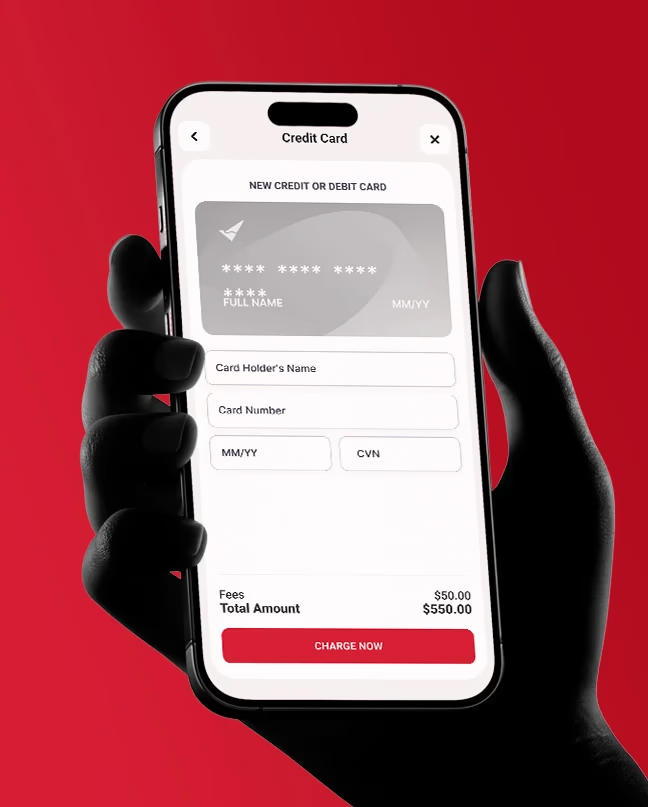
On 1 October 2026, Australian businesses will no longer be able to add a surcharge when customers pay using:
Visa
Mastercard
Eftpos
American Express
This applies to credit, debit and prepaid cards used online, in person, over the phone, through payment links or for recurring payments.
Businesses will still pay fees to accept card payments. The difference is that these fees can no longer be added separately to the amount paid by the customer.
If your business currently charges customers a card surcharge, now is the time to understand what the change could cost you and prepare your payment systems and pricing.
This article covers what a surcharge actually is, what the Reserve Bank has decided, which payments are affected and which are not, the fee cuts arriving alongside the ban, and what any business that currently surcharges should be doing between now and October.
What a surcharge actually is
When a customer pays by card, your business pays a fee to process that payment. For example, if your card fee is 1.5%, accepting a $1,000 card payment costs your business around $15.
A surcharge passes that cost on to the customer, rather than your business absorbing it.
Under the current rules (prior to 1 Oct 2026), you can surcharge customers, but you cannot charge more than it actually costs you to accept that payment method.
This is important because a surcharge isn't designed to make your business money. It simply covers a cost you would otherwise have to pay.
And because card fees are usually based on the value of the payment, the cost increases as the payment gets larger. A 1.5% card fee costs you 75¢ on a $50 payment, but $75 on a $5,000 payment.
What is changing?
Currently, many businesses add a card surcharge to recover the cost of processing a card payment.
For example, a business may charge a customer $101.50 for a $100 purchase, with the additional $1.50 covering the card-processing cost.
From 1 October 2026, businesses will no longer be able to add a surcharge to Visa, Mastercard, eftpos or American Express payments. A customer paying by card must be charged the same price as a customer using another payment method.
Importantly, this reverses a long-standing approach to card surcharging. Previously, the RBA required Visa and Mastercard to allow businesses to surcharge customers, helping make the cost of accepting card payments more transparent.
From 1 October 2026, that requirement will be removed. Visa and Mastercard will therefore be able to enforce their own no-surcharge rules, preventing businesses from passing those card acceptance costs directly on to customers.
This means that continuing to surcharge after the change could put your business in breach of VISA and Mastercards. You will need to make sure your payment setup is updated before the new rules take effect.
Which payments are affected?
The change applies to Visa, Mastercard, eftpos and American Express card payments, including:
Online and in-person card payments
Payments made over the phone
Payment links
Recurring card payments
Cards securely saved on file
Debit, credit and prepaid cards
For businesses, the outcome is simple: from 1 October 2026, you will no longer be able to add a surcharge when a customer pays by AMEX, eftpos, Mastercard or Visa.
Which payments are not affected?
The card surcharge changes do not apply to payment methods that do not use these card networks, including:
PayID
PayTo
Direct Debit from a bank account
BPAY
Standard bank transfers
However, this does not mean a business can automatically charge any fee it chooses for these payment methods. Any fee must still be clearly disclosed and comply with Australian Consumer Law and any other applicable requirements.
Will business still pay card-processing fees?
Yes. Businesses will continue to pay fees when accepting card payments.
The RBA is reducing some of the wholesale fees that contribute to card-processing costs from 1 October 2026. However, these wholesale fees are only one part of the total cost charged by a payment provider.
This means your total card-processing rate may not reduce by the same amount. The effect will depend on factors such as:
The types of cards your customers use
Whether cards are Australian or foreign-issued
Your transaction values and volumes
Your payment provider’s pricing
Pay Advantage is reviewing these changes and will communicate any relevant pricing updates to its merchants.
What could the change cost your business?
The effect will depend on how many card payments you accept, their average value and whether you currently recover your processing costs through surcharging.
For example, if a customer pays a $500 invoice by card and your processing cost is 1.68%, your business pays $8.40 to process that payment.
If you currently pass that $8.40 on to the customer, your business will need to absorb it from 1 October 2026.
The impact may be greater if your business:
Accepts large card payments
Processes a high number of card transactions
Operates on low profit margins
Accepts many international, virtual or commercial cards
Currently passes all card-processing costs on to customers
If you already absorb card-processing fees, the financial impact should be limited. However, you should still check that your website, invoices and payment systems do not refer to card surcharges.
What should your business do now?
1. Work out what card payments cost you
Review at least three months of payment statements and identify:
How much you paid in card-processing fees
How much you recovered through card surcharges
Your average card transaction value
The types of cards your customers commonly use
This will help you estimate what your business may need to absorb after the change.
2. Review your pricing
Businesses may include payment-processing costs within their overall pricing rather than charging a separate card surcharge.
Before increasing prices, consider how many customers actually pay by card and how much the change will cost your business overall. Simply adding your current surcharge percentage to every price may result in customers who use lower-cost payment methods paying more than necessary.
Your accountant or financial adviser can help you decide whether your pricing needs to change.
3. Check how surcharging will be turned off
Ask your payment provider whether card surcharging will be disabled automatically or whether you need to change your settings.
Check every place where your business accepts or refers to card payments, including:
Payment terminals
Online checkouts
Payment links
Booking platforms
Invoice templates
Recurring payment arrangements
Phone payment processes
Pay Advantage will automatically switch off card surcharging for affected card payments from 1 October 2026.
If you use another provider or connected software platform alongside Pay Advantage, check whether you need to make changes within those systems separately.
4. Update your customer information
Remove card surcharge references from your:
Terms and conditions
Quotes and invoices
Booking confirmations
Customer agreements
Website and FAQs
Email templates
Signs and printed material
Try to complete these updates before 1 October 2026.
5. Consider lower-cost payment options
The changes do not prevent your business from offering customers different ways to pay.
This is important because card fees are usually calculated as a percentage of the payment. The larger the payment, the more it may cost your business.
Some account-to-account payment methods instead charge a flat transaction fee.
For example, a PayID payment through Pay Advantage costs a flat $0.48, whether the customer pays $50 or $5,000.
If a $2,000 card payment costs 1.68% plus $0.33, the processing fee would be $33.93. The same $2,000 payment made using PayID would cost $0.48.
Businesses that accept larger payments may be able to reduce their costs by making lower-cost options such as PayID more visible and convenient for customers.
There are 4 great strategies to use if you join Pay Advantage as your payment provider. https://www.payadvantage.com.au/credit-card-surcharge-ban
6. Let your bookkeeper or accountant know
If you record surcharge income separately, removing it changes how payments appear in your accounts, your reporting and your GST reconciliation. Flagging it early makes it easier to compare against previous periods once that line stops appearing.
The opportunity most businesses are overlooking
The surcharge ban means you can no longer pass your card fees on to customers. But you can still reduce those costs by giving customers more ways to pay.
Not every payment method costs your business the same amount.
Card fees are usually charged as a percentage, which means the larger the payment, the more it costs you to accept. Other payment methods, such as PayID, can have a small fixed fee regardless of how much the customer pays.
For example, through Pay Advantage:
$2,000 paid by card at 1.68% + 33¢ = $33.93
$2,000 paid by PayID = 48¢
That's a saving of $33.45 on a single payment.
And the larger the payment, the greater that difference can become.
So rather than simply accepting higher card costs after the surcharge ban, there are several ways you can encourage customers towards lower-cost ways to pay:
Make lower-cost payment methods easy to choose. Give options such as PayID or PayTo greater visibility when customers pay. You can also explain that choosing these methods helps your business keep payment costs down.
Use fixed-fee payment methods for larger payments. This is where the savings can become significant. A card fee continues to increase with the size of the payment, while a fixed payment fee stays the same.
Consider rewarding customers for choosing a cheaper payment method. Instead of adding a surcharge for an expensive payment method, you may be able to offer a discount for choosing a lower-cost option. Make sure any approach you use complies with the applicable rules.
Consider whether you need to accept cards for very large payments. If accepting a large payment by card becomes too expensive, you could set a maximum card payment amount and offer lower-cost payment methods for payments above that amount.
The important point is that losing card surcharges doesn't mean losing control over your payment costs. The businesses that adapt well will look at how their customers pay and make lower-cost payment methods easier and more attractive to use.
The dates that matter
31 March 2026 — the RBA confirmed the changes and when they would take effect.
1 October 2026 — card surcharging ends for eftpos, Mastercard, Visa and American Express. New lower fee caps for many Australian card payments also begin.
1 April 2027 — new fee caps for foreign-issued cards take effect, along with further requirements designed to make payment costs more transparent.
Start preparing now
The most important steps are to understand what card payments currently cost your business, estimate how much you will need to absorb and confirm how surcharging will be removed from your payment systems.
For practical examples and a preparation checklist, download our Guide to Preparing for the Card Surcharge Ban.
Pay Advantage offers cards alongside payment options such as PayID, PayTo, Direct Debit and BPAY, helping businesses provide customers with convenient choices while managing their payment costs.
Already using Pay Advantage? Card surcharging for affected payments will be automatically switched off from 1 October 2026. Contact our support team if you would like help reviewing the payment options available on your account. If you want to explore your options, our guide to reducing payment costs after the surcharge ban walks through the different strategies and shows what they could mean for your business.
Not using Pay Advantage? Call us on 1300 641 310 to discuss how Pay Advantage could help your business prepare.
This article provides general information only and does not constitute legal, accounting or financial advice. Review your merchant agreement and speak with an appropriate adviser about how the changes may affect your business. Full details are available from the Reserve Bank of Australia.
Written by